
ABSTRACT:
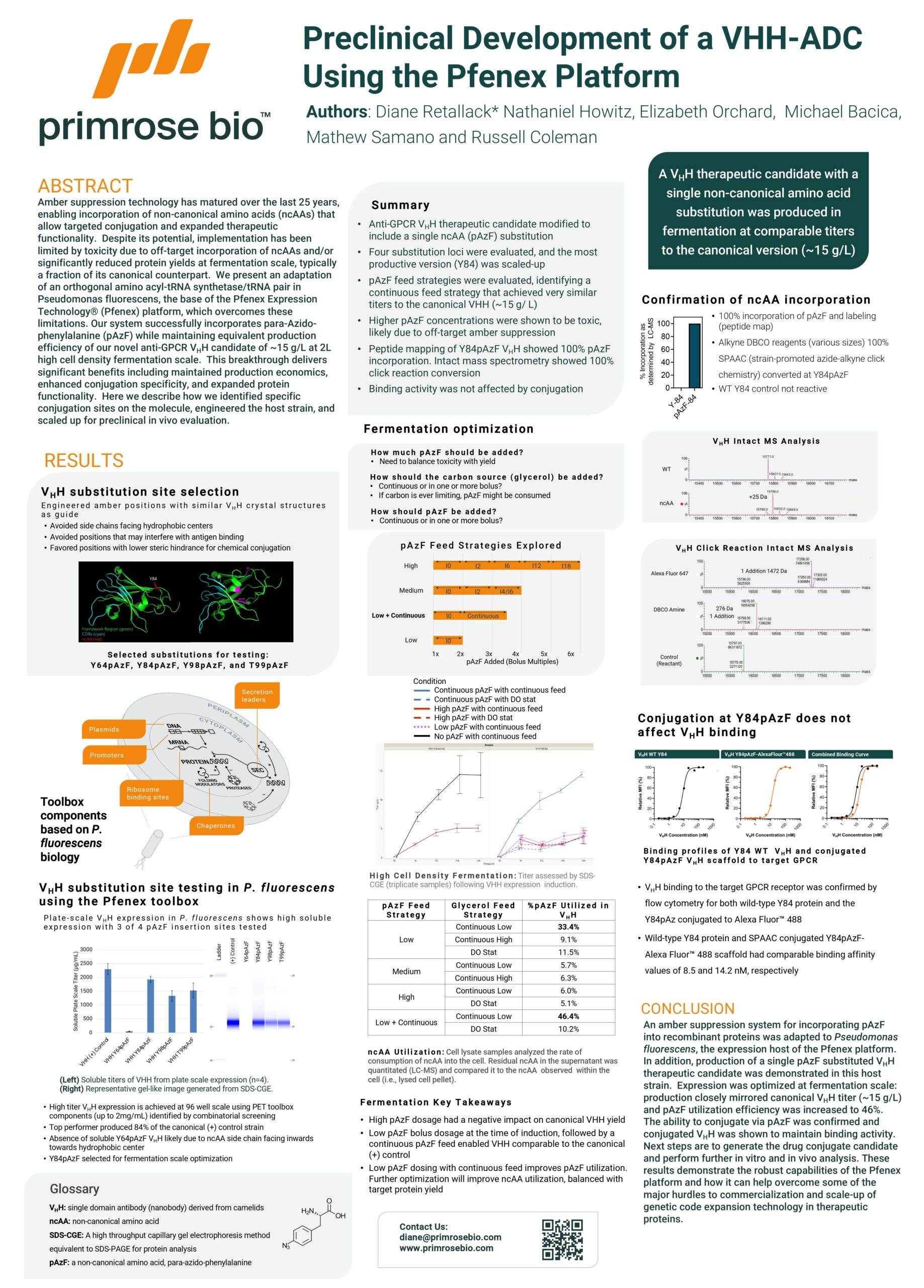
Amber suppression technology has matured over the last 25 years, enabling incorporation of non-canonical amino acids (ncAAs) that allow targeted conjugation and expanded therapeutic functionality. Despite its potential, implementation has been limited by toxicity due to off-target incorporation of ncAAs and/or significantly reduced protein yields at fermentation scale, typically a fraction of its canonical counterpart. We present an adaptation of an orthogonal amino acyl-tRNA synthetase/tRNA pair in Pseudomonas fluorescens, the base of the Pfenex Expression Technology® (Pfenex) platform, which overcomes these limitations. Our system successfully incorporates para-Azido- phenylalanine (pAzF) while maintaining equivalent production efficiency of our novel anti-GPCR VHH candidate of ~15 g/L at 2L high cell density fermentation scale. This breakthrough delivers significant benefits including maintained production economics, enhanced conjugation specificity, and expanded protein functionality. Here we describe how we identified specific conjugation sites on the molecule, engineered the host strain, and scaled up for preclinical in vivo evaluation.